KEY TAKEAWAYS
- How BCMobile enables fast, accurate, and repeatable surface energy measurement outside the lab.
This article explains how BCMobile combines patented Ballistic Deposition, top-down imaging, and machine learning to deliver reliable water contact angle measurements in real-world manufacturing, quality, and operational environments. - Why BCMobile outperforms traditional goniometers for quality-critical applications.
We explore how improved sensitivity, accuracy at low contact angles, and robustness to surface roughness make BCMobile better suited for validating cleaning, activation, and coating processes. - Where BCMobile adds value across industries and workflows.
Using examples from aerospace and other advanced manufacturing sectors, the blog highlights how BCMobile supports product development, process engineering, quality control, training, and repair.
In manufacturing and research, the quality and consistency of surface treatments directly impact performance and reliability. Traditional measurement tools, like standard goniometers, often struggle to provide accurate, repeatable contact angle measurements on complex surfaces. Brighton Science’s BConnect system is designed to outperform these standards, offering precision, speed, and versatility in surface characterization.
Why Accuracy Matters in Surface Measurement
Whether developing new materials, optimizing manufacturing processes, or maintaining critical components, knowing the exact surface energy of your parts is essential. Small variations can impact:
- Adhesion of coatings and lubricants
- Cleaning and contamination protocols
.png?width=327&height=191&name=Cleaning%20Processes%20(Blog).png)
- Component performance and reliability
BConnect uses advanced methods to provide highly sensitive, repeatable, and traceable measurements that exceed the capabilities of standard goniometers.
How BConnect Works: Advanced Contact Angle Measurement
At the heart of BConnect is our patented Ballistic Deposition technology, which constructs a controlled drop on a surface from a series of microdrops. Key advantages include:
- High sensitivity to surface energy changes
- Generates a contact angle, with receding characteristics, which is more sensitive than pure advancing techniques to certain contaminants and surface conditions.
- Robustness against surface roughness
- Measurements remain reliable even on uneven or textured surfaces.
- Non-contact deployment
- Avoids contamination and damage to sensitive surfaces.
- High spatial precision
- Drops can be reduced to interrogate areas as small as 1 mm.
- Placement is exact, making it ideal for small or complex geometries.
- Speed and efficiency
- Deposition occurs in under 100 ms, enabling rapid sampling across multiple sites.

Top-Down Measurement: Unmatched Accuracy and Repeatability
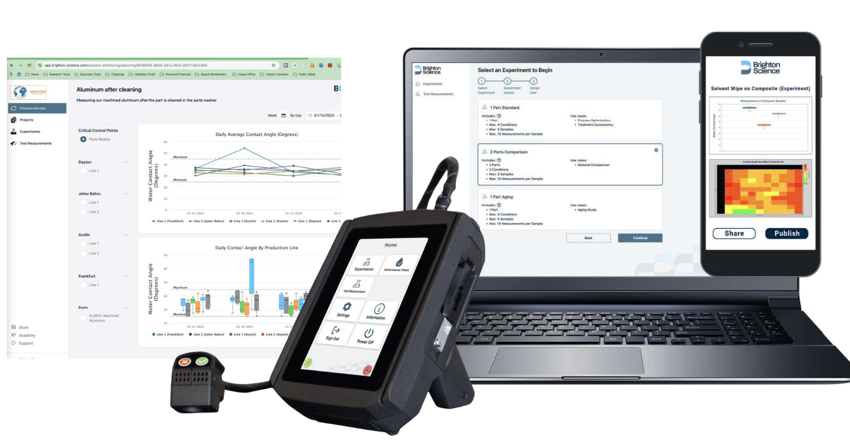
BCMobile uses a top-down imaging approach that tightly controls drop volume and precisely characterizes drop geometry. By combining custom edge-finding software with machine-learning-based droplet detection, BCMobile returns accurate and repeatable water contact angle values in under two seconds.
Machine learning is used to automatically identify the precise edge of the water droplet in each measurement. The model is trained on a large and diverse set of real-world images in which droplet boundaries are carefully labeled. By learning the visual characteristics that define a true droplet edge across different surfaces, lighting conditions, and droplet shapes, BCMobile reliably detects the correct boundary in real time. This improves both measurement consistency and accuracy, especially in environments where traditional edge-detection methods struggle.
This top-down approach delivers excellent repeatability, with standard deviations of less than one degree on well-prepared, atomically uniform surfaces. It also provides significantly improved accuracy at very low contact angles, which is critical for applications such as precision cleaning of optics, medical components, and high-reliability electronics. The approach enables measurement on flat, concave, convex, and channeled surfaces. Under most conditions, results fall within one degree of NIST-traceable water contact angle standards, exceeding the performance of traditional side-view goniometers.
Quality Use Cases Across the Aerospace Industry
1. Product Development & R&D- Optimize coatings and surface treatments
- Detect subtle changes in surface energy that affect adhesion and performance
- Monitor and validate cleaning, coating, or etching processes
- Reduce variability by providing highly repeatable measurements
- Establish robust QC protocols with rapid, non-destructive testing
- Ensure consistency across batches and over time
- Provide hands-on insight into surface conditions
- Support maintenance and repair by validating cleaning or coating effectiveness
Conclusion:
BConnect redefines contact angle measurement, delivering precision, speed, and sensitivity that support high-stakes aerospace applications. By providing traceable, repeatable, and highly localized surface measurements, it empowers R&D teams, engineers, and QC professionals to maintain the highest standards of quality and performance.
For teams seeking faster, more accurate surface characterization, BConnect isn’t just an upgrade, it’s a new standard.

BConnect FAQ: Common Questions from Customers
Q: How does BConnect compare to traditional side-view goniometers?
A: BConnect outperforms standard goniometers by providing higher sensitivity to surface energy changes, better repeatability, and sub-degree accuracy even on low contact angles. Unlike side-view goniometers, BConnect can measure concave, convex, or channel surfaces with precise drop placement.
Q: Can BConnect measure very small or complex areas?
A: Yes. Thanks to our Ballistic Deposition technology, BConnect can create drops as small as 1 mm, allowing for accurate surface characterization on small, intricate, or localized regions.
Q: Does surface roughness affect measurements?
A: No. BConnect’s approach is robust against changes in roughness, so you get reliable and repeatable contact angle measurements on textured, patterned, or uneven surfaces.
Q: Is the measurement process destructive or invasive?
A: No. The non-contact deposition ensures that sensitive surfaces are not damaged or contaminated during measurement.
Take the Next Step: Assess Your Surface Intelligence
Understanding surface quality is just the first step. To see how your organization stacks up in leveraging surface data across R&D, manufacturing, and quality, explore Brighton Science’s Surface Intelligence Maturity Model.