

Key Takeaways
- A major packaging manufacturer was experiencing intermittent heat seal failures on a polymer film that should have behaved consistently.
- Dyne pens showed no difference between good film and bad film, which initially misled the team.
- Brighton Science identified a subtle contaminant that dyne pens dissolved on contact, creating false confidence in surface readiness.
- Water contact angle measurements revealed the surface differences that were not detectable with dyne solutions.
- Infrared spectroscopy confirmed the presence of a fatty acid amide slip additive on the surface of the failing film.
- The manufacturer now uses the Surface Analyst to monitor slip migration in real time and prevent future sealing failures
A Film That Looked Clean but Would Not Seal
A large packaging company was facing a frustrating issue. A polymer film used to package paper products was showing intermittent heat seal failures, even though line conditions and resin formulation were unchanged.
Engineers compared the good and bad films using dyne pens, a standard method for gauging surface energy. Both films registered the same value. To the team, that meant surface quality was not the problem. Yet the failures continued.
The company needed answers fast, and they needed a method that could reveal what standard checks were missing. That is when Brighton Science joined the investigation.
When Standard Checks Fail to Catch a Surface Problem
Brighton Science began by evaluating the films with water contact angle measurements. These tests immediately revealed an unexpected pattern:
- Good film showed higher water contact angles
- Bad film showed lower angles despite failing to seal
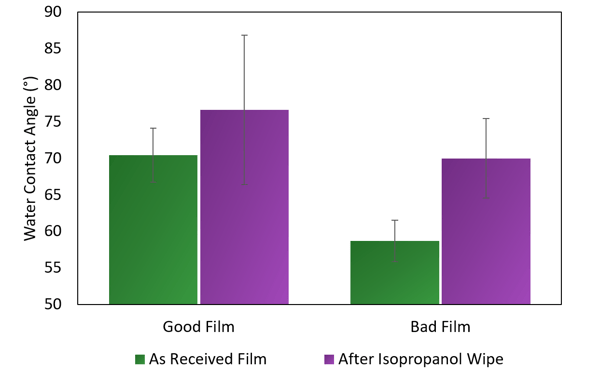
Figure 1. Water contact angle measurements on known good and known bad films before and after a wipe with isopropanol.
This was counterintuitive for the customer. Typically a higher angle indicates a surface that is less active and therefore harder to bond. In this case, the opposite was happening. Something hydrophilic appeared to be sitting on the bad film surface, driving the angle down and interrupting heat sealing.
Tip from a Surface Scientist:
Water contact angle is often the first clue. When dyne pens fail to differentiate between surfaces, contact angle measurements can uncover subtle contamination that dissolves in alcohol-based dyne inks.
Digging Deeper with Infrared Spectroscopy
To understand what was lowering the contact angle, Brighton Science analyzed the films with infrared spectroscopy. The results showed that:
- The bad film contained an amide group not present on the good film.
- Amide groups are typically hydrophilic, which explained the lower contact angle.
- The polymer film itself is hydrophobic, so the amide was not part of the base material. It had migrated to the surface.
This pointed to one likely source: slip additive.
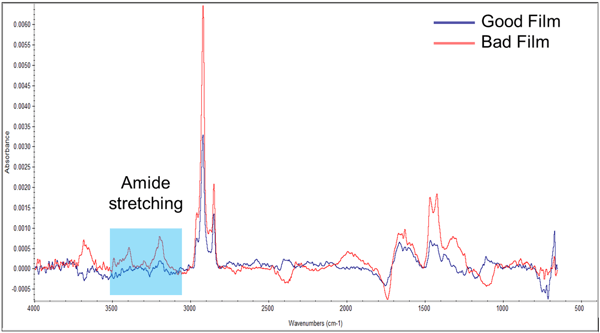
Figure 2. Infrared spectra of known good and known bad films.
Most blown films include a fatty acid amide slip to reduce friction during processing. When present in excess at the surface, slip can interfere with adhesion, coatings, and heat sealing.
Slip additives do not always stay in the bulk material. Heat, time, or formulation changes can pull them toward the surface. Direct surface measurement is the quickest way to catch unwanted migration before it causes failures.
Why Dyne Pens Missed the Contamination
Dyne pens rely on alcohol based inks. Fatty acid amide slip is soluble in alcohol, which meant the dyne ink dissolved the slip during testing. The ink spread as if the surface were clean, giving the manufacturer a false indication that the films were equivalent.
Water, however, does not dissolve slip as readily. Water contact angle behaved differently on the contaminated surface, exposing the inconsistency immediately.
This explained why the process team was stuck. Their measurement method was unintentionally masking the real issue.
Finding the Root Cause and Taking Back Control
Once the contaminant was identified, the manufacturer could take the right corrective actions. Possible contributors included:
- Excess slip in the film formulation
- Residual slip left on rollers from previous runs
- Slip migration caused by elevated temperatures during production
- Changes in corona treatment that altered surface behavior
With the Surface Analyst, the team can now:
- Monitor slip levels on the film during production
- Check rollers for leftover residues
- Adjust corona treatment to control slip migration
- Identify when environmental conditions begin influencing surface performance
- Verify surface quality before sealing begins
The costly guesswork is gone. The manufacturer now has the data they need to maintain consistent, reliable seals.
Monitoring during production is the real breakthrough. Once a contaminant is identified, the most effective long term solution is continuous surface measurement that catches migration, residue, or environmental shifts before they cause failures.
Conclusion
This investigation showed how a seemingly minor surface variable can create major production and quality problems when it goes undetected. The packaging manufacturer had the right people and the right processes, but their measurement method was not sensitive enough to reveal what was truly happening at the surface. Once the slip additive was identified and quantified with reliable surface data, the path forward became clear.
By combining water contact angle measurements, targeted chemical analysis, and ongoing surface monitoring, the team transformed a recurring, costly issue into a controlled and predictable part of their workflow. Today they have full visibility into slip migration, can intervene before heat sealing failures develop, and can validate surface conditions with confidence.
This case reinforces a simple truth in modern manufacturing: when surface quality is measurable, it becomes manageable. Tools like the Surface Analyst and BConnect give teams the clarity they need to prevent failures, improve yields, and maintain strong customer relationships.
Q&A: Understanding the Case
Q: What made this contamination difficult to detect?
A: The slip additive dissolved in alcohol based dyne inks, which made dyne testing produce a false indication of a clean surface.
Q: Why was water contact angle more effective?
A: Water does not dissolve the slip in the same way, so the measurement revealed the surface differences that dyne pens masked.
Q: What confirmed the identity of the contaminant?
A: Infrared spectroscopy detected an amide group associated with fatty acid amide slip, which was present only on the bad films.
Q: How can manufacturers prevent this in the future?
A: Continuous surface quality monitoring with tools like the Surface Analyst and BConnect allows teams to detect slip migration or contamination early and take corrective action before yield is affected.
Discover how BConnect brings surface quality data into your production workflows. Request a walkthrough of BConnect today.
