

Key Takeaways
- Verification at every step is essential. Multi-stage surface preparation workflows in aircraft assembly and repair require stepwise validation to ensure each action contributes to a bond-ready surface.
- Unexpected contamination can originate within the process itself. In this case, a reused and highly contaminated solvent was unknowingly degrading surface quality instead of improving it.
- Contact angle measurements reveal process drift immediately. Real-time Surface Analyst readings showed surface cleanliness improving after initial steps, then suddenly worsening, pointing directly to the problematic step.
- Simple visibility checks are not enough. Although the reused solvent eventually appeared visibly dirty, contamination levels become problematic long before visual indicators appear.
- Implementing in-place verification strengthens the entire workflow. With reliable measurement of surface quality at each stage, the manufacturer refined its procedures, eliminated variation, and improved both efficiency and bond reliability.
The surface preparation processes used to assemble or repair an aircraft include multiple steps to achieve a final bond. For a strong, safe, and effective bond, all steps in the process must be consistent and validated prior to moving forward in the process.
So, how can aircraft manufacturers know that each step in the process is complete to a satisfactory degree when there previously have been only outdated, ineffective, or objective methods?
The effects of this crucial question can be summed up by saying when the desired result is not produced, every surface preparation step must be re-examined.
The Material & Process
An engineer from an aircraft manufacturer specializing in major defense applications was teaching mechanics how to use the Surface Analyst to verify clean composite surfaces during their assembly process.
Their surface preparation process included three steps: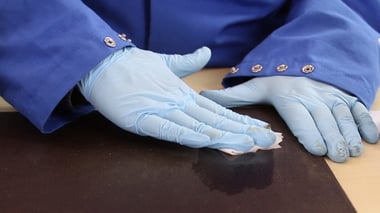
• solvent wipe
• hand abrasion
• varied solvent wipe
The Problem
After these steps, the engineer measured the composite panel surface using the Surface Analyst. The contact angle was incredibly high, at around 70°.
How could this surface display such poor quality when the "proper" steps were being taken to prepare it appropriately for bonding?
In a typical preparation process situation, the higher the contact angle, the less reactive or "dirty" the surface is. The lower the contact angle, the more reactive or "clean" the surface is. These measurements indicate a surface's preparedness for bonding.
Needless to say, this measurement tilted a few heads. Their surface showed more contamination after the specified preparation process than before! When and where in the process was this happening?
The Measurements
The original contact angle taken prior to any surface treatment read 70°.
• After the first solvent wipe, the contact angle read 50°
• After the hand abrasion, 30°
• After the final step of the solvent wipe, the contact angle read higher than the original angle of 70°
The Solution
These findings led them to investigate the solvent itself, which was stored in an opaque container. The team poured the solvent into a clean beaker.
Surprisingly, the cleaner was a dark charcoal color rather than clear. That's when the team explained to the engineer that they first had been using the solvent to soak other parts and then poured it into a container to be reused in the next step of the process.
The Surface Analyst revealed that the manufacturer was using an extremely contaminated solvent to "clean" their surfaces. While the coloring of this solvent is obvious contamination, a solvent can quickly obtain contamination and may lose its integrity well before showing physical proof. But, with in-place verification procedures with the Surface Analyst, the quality of a solvent would never be ambiguous.
The Results
Based on these results, the company refined its surface preparation process and use of the solvent protocol.
These new procedures were made possible due to the Surface Analyst. The instrument detected and identified the Achilles heel of the surface preparation process.
As a result, the company’s process became stronger and more efficient. For technicians, mechanics, engineers, and anyone involved in the manufacturing process, the Surface Analyst verifies the surface's proper preparation within every step of the process and can troubleshoot reliably when issues arise. These uses and several others, demonstrate how the Surface Analyst can improve and monitor the surface preparation process for reliable bonds.
Frequently Asked Questions
Why was the final solvent wipe causing more contamination instead of cleaning the surface?
The solvent used in the final step had been repeatedly reused to soak other parts. By the time it was applied, it contained significant contamination, which transferred directly to the composite surface.
How did the team identify the contaminated solvent?
After suspecting the solvent itself, the team poured it into a clean beaker and found it was dark charcoal instead of clear. The Surface Analyst readings confirmed its failure to clean the surface effectively.
What role did the Surface Analyst play in diagnosing the issue?
It provided objective, step-by-step contact angle measurements. When angles dropped after the early steps and then spiked above the original value after the final wipe, the measurement pattern made it clear that the last step was introducing contamination.
What changes did the manufacturer make after discovering the issue?
They refined their solvent handling protocol and updated their surface preparation workflow to ensure clean, validated steps throughout the process. The Surface Analyst became an integral tool for ongoing verification.
Why is in-process verification so important for aircraft assembly and repair?
Bonded structures in aerospace must meet extremely high reliability standards. Without quantitative verification, contamination can go unnoticed until it causes failures. Tools like the Surface Analyst prevent rework, scrap, and risk by confirming surface readiness at every stage.