

Temperature and humidity play a role in a lot of adhesion processes - how fast an adhesive cures, whether a surface is prone to corrosion, or how a coating flows and levels. So, it’s a fair question:
Do those same conditions affect the validity of a water contact angle (WCA) measurement?
Short answer: not in the way most people expect. Here’s why.
What a WCA Measurement is Actually Capturing
At its core, a water contact angle measurement reflects a balance between three things:
-
The surface tension of the water droplet, which is a measure of how strongly the liquid is attracted to itself
-
The surface energy of the material, a measure of how strongly the solid attracts other substances
-
The interfacial energy, which is the energy ‘left over’ at the interface after the solid interacts with the liquid
When a drop is placed on a surface, when it stops moving, all of the forces are in equilibrium with each other. The contact angle you measure is a direct result of that balance of forces.
.png?width=372&height=204&name=Surface%20Energy%20of%20a%20Solid%20and%20Liquid%20(Blog).png)
.png?width=306&height=257&name=Water%20Contact%20Angle%20Diagram%20(Blog).png)
So, when people ask about temperature or humidity, the real question is:
Do those conditions meaningfully change that balance?
In most real-world environments, they don’t.
Temperature affects both the solid and the liquid in the same way and has little effect on the equilibrium.
As temperature increases:
- The surface energy of the solid decreases slightly
- The surface tension of the water also decreases
Both forces shift. Importantly, they shift together.
Because contact angle measurements depend on the relationship between those two values, the changes largely cancel out. The result is a measurement that stays stable, even as temperature varies.
You can think of it simply:
Higher temperature → lower surface energy
Higher temperature → lower surface tension
Net effect on contact angle → minimal
.png?width=551&height=289&name=Water%20Contact%20Angle%20-%20Low%20and%20High%20Temperature%20(Blog).png)
One related factor worth mentioning is viscosity. Warmer water behaves differently as it flows, which could theoretically affect droplet formation. In practice, this is controlled by the Surface Analyst’s Ballistic Drop Deposition method, which ensures consistent, repeatable droplet placement regardless of temperature.
Humidity isn’t a direct factor
Humidity tends to raise more concern, but it doesn’t directly affect a WCA measurement.
That’s because the measurement is defined by the interaction between a liquid and a surface, where the liquid is already in equilibrium with its vapor. Ambient humidity doesn’t meaningfully change that interaction.
Where humidity can matter is over time.
If a surface sits in a high-humidity environment long enough, it may begin to oxidize or corrode. That changes the surface chemistry- and your contact angle will change with it.
But that’s not measurement error. That’s the measurement doing its job.
We tested it
To validate this, instruments were stored in environmental chambers across a wide range of conditions- from 50°F / 15% RH to 80°F / 90% RH- for up to 96 hours.
Measurements were taken throughout.
The result: contact angle values remained consistent, staying within normal measurement variation. Whether conditions resembled a dry storage room or a hot, humid production floor, there was no meaningful drift.
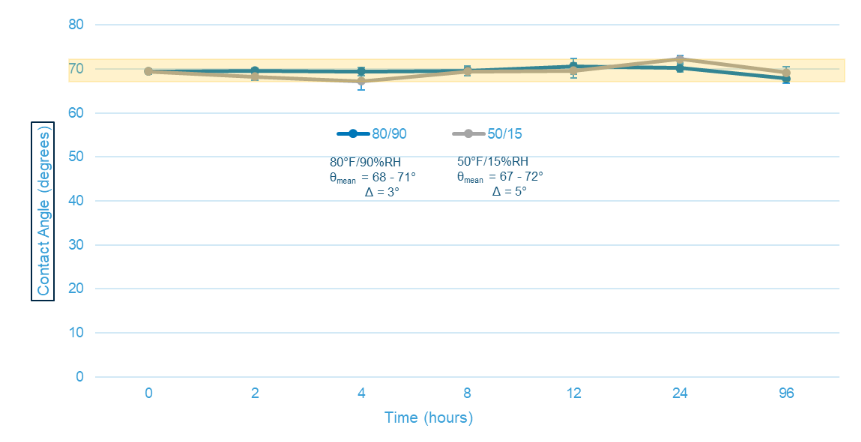
Figure 3. Effect of temperature and humidity on water contact angles measured on a test surface using the Surface Analyst. Instruments were stored in environmental chambers at either 80°F/90%RH or 50°F/15% RH for up to 96 hours, with contact angle measurements taken at various intervals.
What this means in practice
If you’re using the Surface Analyst on a production floor, you don’t need to worry about whether it was warm that day or whether humidity was high.
Your WCA data is reflecting the condition of the surface- not the environment around it.
That’s the goal of surface intelligence: giving you reliable, actionable data in real manufacturing conditions, not just in a controlled lab.
Want to go deeper?
This post covers the practical takeaway.
If you want the full technical explanation- including the Young equation framework and detailed experimental data- the white paper “Evaluating the Influence of Temperature and Humidity on Surface Energy and Contact Angle”
